Showing posts with label tom hanks. Show all posts

Monday, March 12, 2012

The Terminal Man: Sir Alfred Mehran

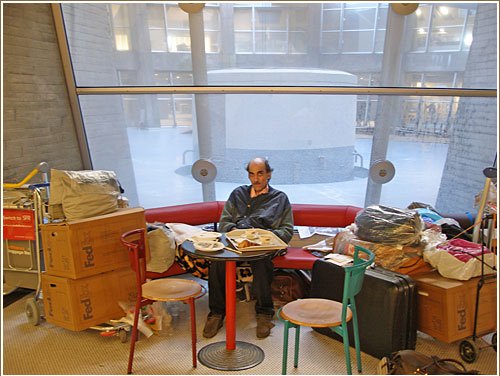
Sir Alfred and belongings at Charles de Gaulle.
I recently finished The Terminal Man, an autobiography by Sir Alfred Mehran also known as Mehran Karimi Nasseri. In case you're not familiar with the name, Alfred is perhaps the most famous homeless man in history. He lived in Terminal One of Charles De Gaulle airport for approximately sixteen years, starting in 1988.

The autobiography itself was unique in the way that language was used. Alfred has a nack for using repetition for emphasis and for explaining some things in more detail than would otherwise be required.

Of all the homeless people I have met in my lifetime, it was encouraging to read this autobiography. For once, someone wasn't asking for money. In fact, on multiple occasions, people offered to send him money to help but he refused - he wasn't taking money from anyone. Food, on the other hand, was the only exception. Food and paper, that is. He kept a journal every day for his stay at Charles de Gaulle in France. The autobiography hardly contains a fraction of those entries.

Learning the background of this man and how he came to be stuck in the airport is a story you yourself should discover. Though this isn't as fast-paced as you might like, read it with respect remembering that the author lived sixteen years on a bench and then brought this perspective to you. You'll be as fascinated as I was to learn how Alfred's home went from nothing to becoming a bench at an airport.

It is my understanding that Steven Spielberg has never officially announced that The Terminal was based on Alfred's life but he did, in fact, pay Alfred $300,000 for rights to Alfred's life story prior to production of The Terminal, starring Tom Hanks and Catherine Zeta-Jones. Therefore, it is my opinion after having read the autobiography and having seen the film that The Terminal is based on the situation of Sir Alfred Mehran.

If you've seen the movie and want to learn more about where the idea came from, read this book. You're sure to finish the last page with a new perspective on government, life and appreciation for the simple things.

Saturday, February 18, 2012

Road to Perdition by Max Allan Collins: My First Graphic Novel

Road to Perdition by Max Allan Collins is, as you might have guessed, the graphic novel that inspired the Dreamworks film by the same name starring Tom Hanks and Tyler Hoechlin. It tells the tale of Michael O'Sullivan, a family man who works for mafia-involved Mr. Looney. Michael is known as the archangel of death to people near and far or "the angel" for short. When one of Michael's two sons, Michael O'Sullivan Jr. witnesses his father and Looney's son Connor kill a group of men, Connor tells his father, Mr. Looney who gives a sealed envelope containing Michael's death-sentence to be delivered to his would-be murderer in exchange for forgiveness of all debts.  Looney had allegedly only ordered the death of Michael that night but Connor, on his own initiative visits the O'Sullivan home in the night killing all who were home which were his wife and youngest son. Luckily Michael O'Sullivan Jr. wasn't home yet but he unfortunately walked in to find his mother and brother dead. This is just the beginning.

The rest of the graphic novel tells the tale of father and son on the road, running from Looney's men. Finding that Al Capone's allegiance still remains with Looney, Michael is forced to avenge the death of his family on his own with Michael O'Sullivan Jr. alongside. Michael Sr. is a noble man but his son puts it best when he says his father was no saint but he also wasn't a butcher.
Tyler Hoechlin as
Michael O'Sullivan Jr.

One of the most precious parts of the film to me was the fact that the son never had to murder. He held a gun several times and nearly killed Jude Law's character, Harlen (an assassin hired by Nitti, Capone's man, at the approval of Looney) before his father stepped in and saved his son the lifetime burden. In the graphic novel however, Michael Jr. saves his father's life by killing a man intending to do the same to Michael Sr.

Another major difference between the film and graphic novel would be the fact that Jude Law's character, Harlen, doesn't even exist in the graphic novel. I loved his character in the film and how he tracked the O'Sullivans throughout the story but sorely missed his presence and demeanor in the book.
Jude Law as Harlen, the assassin
from the film Road to Perdition

The adaptation from book to film was, aside from previously mentioned major differences, very impressive. I hadn't realized how graphic novels were similar to films until I found myself engrossed in the "rat tat tats," "bam bam blams," and the fast, thrilling story line of outstanding art and character. When reading a traditional novel, detail is the jewel - graphic novels, however, play to the imagination, the reader's interpretation of art stills and a dynamic story line.

This was my first graphic novel experience. Having previously thought graphic novels and comics were for men and women enthralled with the pleasures of their youths, I must admit how sorely mistaken I was. Graphic novels span all ages, imaginations and interests. I'm glad I took a ride on The Road to Perdition and I hope you will too.

film images property of Dreamworks and Twentieth Century Fox

Wednesday, February 15, 2012

Gump & Co. by Winston Groom

If you're like me you're surprised to hear that there's a sequel to one of America's most heart-warming stories, Forrest Gump. Winston Groom originally wrote Forrest Gump (1986) and then agreed to the movie deal (1994). Following the release of the film, Groom released his sequel to the story in 1995, Gump & Co.

There are many new, wonderful adventures in store for Forrest Gump in this second book. For example, he invents a new Coca-Cola product, works on a pig farm, meets Lieutenant Dan and Sue (his orangutan I mentioned from the first book) again, joins the army again in World War I, meets the President, unknowingly becomes President of an insider trading business, meets Tom Hanks (the actor portraying Forrest in the 1994 film) and embarks on many more adventures, disasters and experiences. Needless to say, Forrest is still not the Forrest we know from Hollywood. However, he is the father I wanted so badly to see.

The book is begun with the death of Jenny and his mama. There's hardly any time dwelt on either of these occurrences but throughout the book Forrest sees Jenny in times of need and hears her advice. Forrest must raise "Little Forrest" no matter the distance between them. It proves a challenging but fruitful task and became the most treasured part of the entire novel for me.

I struggled a bit with Forrest Gump meeting Tom Hanks. Having seen the film before reading the first book, I already had a Forrest in mind before reading the first page. I'm not sure how my brain survived the collision on these two figures across the span of pages they shared, but it was difficult.

The "shrimpin' bidness" started in the first book fails tragically to environmental factors and a crooked accountant runs off with the remaining millions. However, by the end of this second book, Forrest starts up an oyster business in the same area he "struck gold" with shrimp. The story ends sweetly with the oyster business finding success, Forrest raising one of the brightest young men and being the best friend to all he's met along the way.

If you want to know what the creator of Forrest intended for Forrest following the film's release, read this book. Though it's impossible to take off from the film since the book was so very different, Groom does his best to tie them together in this second, and final story; thus ends the tale of Forrest Gump, fiction and film.


If you love Forrest Gump, you should check out the:

Saturday, January 28, 2012

Forrest Gump by Winston Groom

In a mere 2.25 days, I opened and closed the book Forrest Gump by Winston Groom. As you may already know, Forrest is an idiot-savant and goes through the book and movie telling us his account of life - we're invited to see things through his eyes. The book takes us through multiple time periods in U.S. history and is a pure delight to devour.

The book, as you might imagine, is very different from the movie. In the book Forrest demonstrates his savant capabilities in the following ways, to name a few:

  • His chess skills are out-of-this-world
  • His ping-pong capabilities over-shadow most
  • He can wrestle like none you've ever seen
  • He's the best dang quarterback in the region
  • He's a natural master physician and mathematician
However the movie hardly illustrates much more than ping-pong and rifle assembly/dis-assembly. Here are a few more differences. In the book...
  • Mama nor Jenny pass away
  • Lieutenant Dan doesn't help start the "s'rimpin bidness"
  • There is no wedding and no Lieutenant Dan with shiny new legs
  • Forrest wins $10,000 in wrestling
  • Forrest auditions for a Hollywood movie
  • Forrest goes to space in a rocket (and New Guinea as a result)
  • Forrest has a male orangutan named Sue
  • Forrest runs for senate with the slogan, "I gotta pee!"
I'll stop there but at this point you may be asking yourself, "So what DO they have in common?" For the most part, you'll have to read it. However, they do share themes. Innocence, seeing the world through eyes of another, courage, sheer luck and the hard lesson of life and death. The joy of reading this book was well worth the shock of variation between itself and the movie based upon it. I know you'll enjoy an almost entirely different tale of Forrest Gump as I did when you're tangled in the pages, unable to set it down. 

If you love Forrest Gump, you should check out the: